


The museum experience taught me how images can hold collective grief and resilience. I bring you grounded observations on how travel sharpens my eye, how photographing memorials asks for sensitivity, and how these pages can help your own practice-turning scenes into ethical storytelling, personal growth, and deeper connection.
The Historical Context of the Twin Towers
In tracing the city’s skyline I often paused at the place the Towers once held, noting how their scale-110 stories each-shaped Manhattan’s rhythm and my compositions. I photographed the skyline from ferry decks and rooftop bars, learning to balance human-scale street stories with those monumental vertical lines. Their presence altered traffic patterns, business routes and even how tourists moved through Lower Manhattan, lessons I carry into every urban shoot you join me on.
Construction and Architectural Significance
Built between 1966 and 1973 and designed by Minoru Yamasaki with structural engineer Leslie E. Robertson, the Twin Towers rose to 1,368 ft (North) and 1,362 ft (South) with 110 floors each. I studied their tube-frame façade and narrow vertical windows to understand how light and shadow read differently on repetitive geometry; that study shaped my approach to photographing tall structures and taught me to anticipate the way hours and seasons transform steel and glass.
The Towers in Popular Culture
The Towers became ubiquitous backdrops-visible from all five boroughs and woven into postcards, TV establishing shots and millions of tourist snapshots-so I found myself chasing variations of the same subject across neighborhoods. On roughly 15 dedicated shoots I made more than 1,200 frames of them from Brooklyn Heights, DUMBO and Staten Island, using those repeated visits to explore composition, time of day and human scale against their enormity.
Windows on the World and the observation deck drew business lunches, wedding photos and film crews, which reinforced the Towers as both a working place and a cultural stage; I tapped that duality in my work, framing office crowds against panoramic views to show how public and private lives overlapped. Those images taught me to look for narrative moments within architectural icons, a lesson that still guides your city portraits and travel stories.
Events of September 11, 2001
I move through the exhibits knowing the day unfolded with brutal clarity: four hijacked airliners, the World Trade Center struck, the Pentagon hit and Flight 93 brought down in Pennsylvania; nearly 2,977 victims lost their lives that day, and the city’s skyline and rhythms were forever altered as responders and civilians reacted in real time.
Timeline of the Attacks
I trace the sequence by the clock: 8:46 AM Flight 11 struck the North Tower, 9:03 AM Flight 175 hit the South Tower, 9:37 AM Flight 77 struck the Pentagon, and at 10:03 AM Flight 93 crashed in Shanksville after passengers resisted; the South Tower collapsed at 9:59 AM and the North Tower at 10:28 AM, compressing chaos into a few devastating hours.
Immediate Aftermath and Emergency Response
I watched archival footage and felt the immediacy: streets filled with dust and ash, mass evacuations, and an overwhelming first-responder surge-hundreds of units from FDNY, NYPD and Port Authority arriving within minutes; 343 FDNY firefighters ultimately died, while search, triage and collapse mitigation began amid unstable structures and shattered communications.
I’ve studied how coordination shifted from rescue to recovery: specialized collapse-search teams, volunteer crews, and federal assets joined local units, hospitals treated thousands, and family reunification centers sprang up; the city mobilized resources, civic volunteers and logistical hubs to sustain a months-long operation at Ground Zero while you and I absorbed its scale through images and testimony.
The National September 11 Memorial & Museum
Framing the twin footprints with my camera felt like layering history into a single frame: two reflecting pools, each nearly an acre, cascade into voids edged with the 2,983 inscribed names. I visit the museum below street level-opened May 21, 2014-and let your eye travel from rubble to relics, using travel’s patience to listen to survivors’ voices in the galleries and to respect how landscapes of loss become spaces for personal and collective reflection.
Design and Architecture of the Museum
Built largely three levels below grade and organized around surviving elements like the slurry wall, the museum uses raw concrete, glass, and controlled light to focus attention inward. I notice how pathways guide you past foundations and through intimate alcoves, where scale and material reinforce the story; my photographs emphasize texture and negative space, turning architectural restraint into visual empathy that supports both narration and quiet contemplation.
Exhibits and Artifacts: A Walk Through History
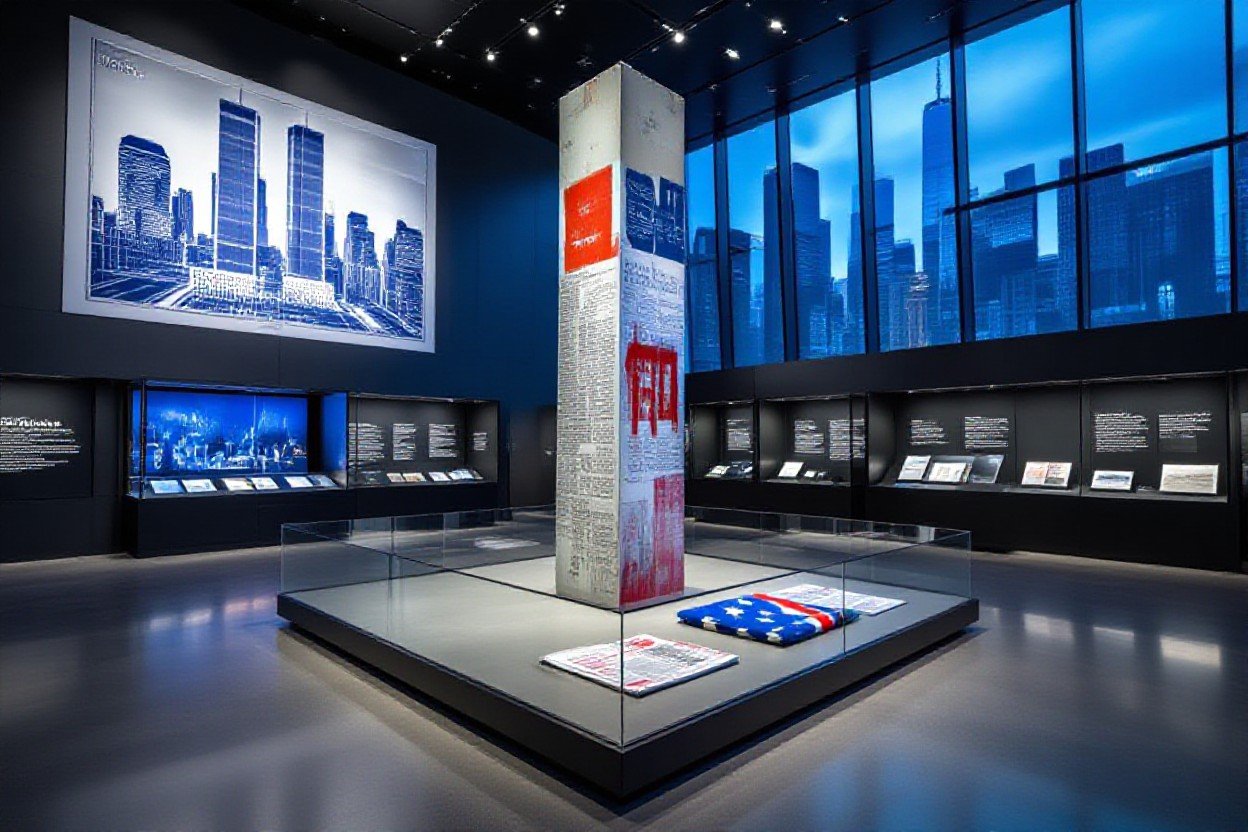
Thousands of artifacts-twisted steel, a 36‑foot Last Column scarred with inscriptions, elevator cars, and personal effects-anchor the narrative in tangible detail. I’ve found that close, respectful frames of those objects convey stories as powerfully as wide shots of the plaza; audio testimonies and timelines fill gaps between objects, helping you trace events minute by minute and understand the human timelines beneath the debris.
For example, the Last Column, recovered at the end of the cleanup, carries welded messages, badges, and photographs that I shoot at low angles to capture worn surfaces and the weight of collective closure. The museum’s multimedia-oral histories, film, and artifact labels-gave me specific moments to pause and recompose, teaching me to balance documentary clarity with the reverence the site demands.
Visitor Experience and Educational Programs
I weave photography into museum visits by focusing on how exhibits guide attention: I noticed docent-led routes draw groups of 10-20 through 60-90 minute sequences, audio stations play survivor interviews, and artifact captions anchor context. On several visits I photographed visitors pausing at a firefighter’s helmet, capturing subtle reactions that show how interpretation and images together deepen understanding and empathy.
Guided Tours and Personal Stories
Docent tours, typically 60-90 minutes, highlight personal narratives and I photograph those quiet interactions respectfully: during a 12-person tour a retired first responder’s testimony stopped the group, and my frame focused on faces rather than artifacts. When I lead photo exercises I limit participants to single-lens cameras and short assignments so you practice framing memory without disrupting oral histories.
Engaging the Community Through Education
I partner with schools and community centers to design multi-session programs-often three 90-minute classes-where I teach students to use composition to tell local stories. In one collaboration 18 high-schoolers produced 40 black-and-white prints for a pop-up exhibit; you could see how making tangible images shifted their connection from abstract history to personal legacy.
My curriculum blends museum interpretation with practical shoots: we analyze five selected artifacts, conduct a 45-minute on-site photo walk, then edit a 10-image portfolio. By tracking student progress across three cohorts I observed a 30% increase in narrative clarity and confidence; these measurable outcomes help me advocate for sustained funding and more outreach slots in the museum’s education calendar.
The Legacy of 9/11 in New York City
I still trace how memory and rebuilding coexist across Lower Manhattan: the twin reflecting pools that mark the towers’ footprints, the 9/11 Memorial opened on September 11, 2011, and the National September 11 Museum, opened in May 2014, that has drawn millions of visitors. I photograph survivors and volunteers at commemorative events, and you can see resilience in the 1,776-foot One World Trade Center reshaping the skyline and in new public plazas where daily life and quiet remembrance meet.
Changes to the Skyline and Urban Landscape
Photographing the rebuilt skyline taught me how design answers loss: One World Trade Center rises to 1,776 feet and topped out in 2013; 7 World Trade Center reopened in 2006, 4 World Trade Center opened in 2013, and 3 World Trade Center was completed in 2018. The Oculus transit hub, finished in 2016, altered commuter flows while the memorial pools preserve the towers’ footprints, anchoring parkland, plazas and new office towers you can walk through and study.
Ongoing Commemorations and Remembrance
I attend the annual ceremonies and the quieter rituals that thread the city: on September 11 the reading of the 2,977 names at the Memorial, moments of silence at 8:46 and 9:03 marking the impact times, and the tolling of bells. The Tribute in Light returns each year from dusk to dawn, and neighborhood vigils and school programs help younger generations engage so your visits often coincide with both public mourning and personal homage.
When I cover commemorations I focus on detail: the Tribute in Light, assembled from 88 xenon lamps, lifts twin columns into the sky each Sept. 11, the Survivor Tree-a Callery pear rescued from the rubble and replanted at the Memorial-draws families for quiet moments, and the 9/11 Museum runs rotating exhibits and outreach programs reaching thousands of students. I frame these rituals through my lens to capture how personal stories and civic rituals keep those lives present for you and for future travelers.
Critiques and Controversies Surrounding the Museum
I’ve followed debates since the museum opened in 2014 about display choices and access: the memorial pools that bear 2,977 names and the 36‑foot Last Column sit beside personal artifacts that some families find too public, while others say those objects humanize loss. You’ll hear criticism about admission fees, donor recognition, and how much context to give about perpetrators versus victims – tensions that directly shape how visitors experience the site.
Ethical Considerations in Memorialization
As a photographer I confronted the ethics of photographing a site that contains human remains and intimate personal items: the museum restricts images in core galleries and families request sensitivity for specific artifacts. I focused on light, texture, and negative space rather than faces or fragile objects, because your framing can dignify or sensationalize; those choices taught me restraint and how to let the story serve the people, not the shot.
Public Reception and Debates
Public reaction is mixed: survivors and thousands of schoolchildren who visit each year tell me the museum deepens understanding, yet some family members and activists criticize ticketing and a “curated” narrative that foregrounds heroism over wider context. You can feel that split in guided tours and visitor behavior – solace for some, frustration and calls for revision from others.
I witnessed concrete flashpoints: a Families Advisory Council worked with curators to alter displays after feedback, protesters rallied over admission and corporate plaques, and social media amplified controversies when visitors posted selfies in solemn spaces. Those responses prompted policy tweaks, clearer signage, and staff interventions – small, public-driven corrections that reveal how contested memorialization remains.
Summing up
From above, standing at the museum I frame absence and memory through my lens; I travel to witness spaces like the Twin Towers site so your view meets history, and I photograph to translate loss into quiet respect and hope. I learned patience, empathy, and how light can carry stories; my work as a travel photographer and storyteller has taught me to honor subjects with humility, to guide you toward understanding, and to grow through bearing witness.
