

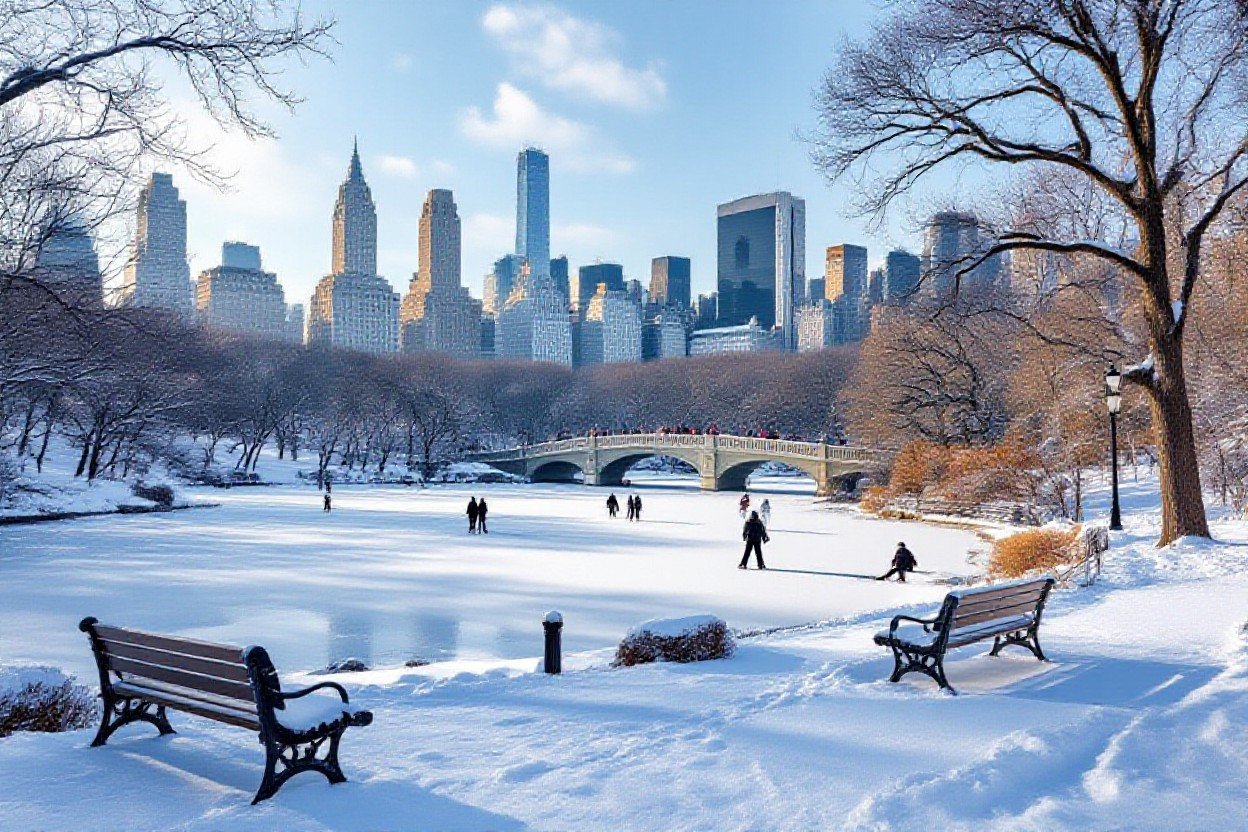
Just step into Central Park in December and I will show you how its frosted trees, quiet paths, and holiday lights transform the city; I describe the best routes, photo vantage points, where to watch skaters at Wollman Rink, and how to time your visit so you can capture the season without crowds. Trust my tips to make your visit efficient and memorable.
Key Takeaways:
- Central Park in December offers a quieter, snow-dusted landscape ideal for peaceful walks and seasonal reflection.
- Festive lights, ice skating, and holiday events create lively pockets amid the park’s natural serenity.
- Low winter light, bare trees, and architectural backdrops provide strong contrasts for moody, cinematic photography.
The Beauty of Central Park in December
I watch Central Park’s 843 acres shift into a stark, quiet palette in December, where architectural details like Bethesda Terrace and Bow Bridge gain new contrast against snow and bare branches. You notice light differently – late-afternoon gold on The Mall’s elm trunks, commuters pausing at gap-toothed paths, and the skyline peeking between leafless branches, giving familiar landmarks an almost cinematic clarity that keeps me coming back each winter.
Snow-Covered Landscapes
On the 15-acre Sheep Meadow, snow flattens crowds into a single white field, while Bethesda Fountain becomes a framed still point beneath icicles. You can trace crisp footprints across The Pond’s frozen margins and watch steam rise off the reservoir on sub-32°F mornings. I often time visits for first light when the blue hour emphasizes Bow Bridge’s arch and the park’s contours feel carved in soft white.
Winter Activities and Attractions
I head to Wollman Rink when I want city skyline skating and to Lasker Rink for quieter laps near the Harlem Meer; both offer public sessions and on-site rentals. You can also sled on Pilgrim Hill and Cedar Hill after a fresh snowfall, and book a horse-drawn carriage along Central Park South for a classic view. These activities pack the park with energy despite shorter daylight hours.
For specifics, public skating schedules typically run daily with morning and evening sessions, skate rentals available on-site, and occasional lessons or themed nights at Wollman; check park websites for current hours. I recommend arriving early on weekends-lines can reach 30-60 minutes-and wearing layered gear, since temperatures near the reservoir often sit several degrees below Midtown street levels.
Wildlife in Winter
I notice Central Park’s wildlife shifts dramatically in December: over 260 bird species have been recorded here, and the park becomes a magnet for overwintering ducks and resident raptors like Pale Male. Your walks reveal flocks on the Reservoir and concentrated activity in shrub belts where squirrels and raccoons forage. I track how open water, vegetation cover, and human feeding alter animal distribution and daily rhythms.
Bird Watching in December
On my December outings I often record 30-40 species during a two-hour walk, with buffleheads and hooded mergansers frequenting the Pond and Reservoir. Binoculars 8×42 pick out plumage details and a spotting scope makes distant gulls and scoters along the Hudson identifiable. You can time visits at dawn for active feeding or midafternoon when raptors like red-tailed hawks patrol tree lines.
Animal Behavior During Cold Months
Temperatures under freezing push animals into energy-saving strategies: I see squirrels caching hundreds of nuts each autumn and relying on those stores, while small birds form mixed-species flocks to reduce predation and conserve heat. Raccoons lower daytime activity and raptors increase hunting along open edges where prey concentrates. You can spot changes in timing-feeding peaks shift toward midday when temperatures are warmest.
During one December field session I watched a red-tailed hawk take three mouse-sized prey in under an hour from a perch by the East Drive, illustrating how predators exploit concentrated prey. Waterfowl often form flocks of 50-100 in unfrozen basins, increasing competition at edges. I recommend observing quietly at a distance so your presence doesn’t scatter feeding birds and distort normal winter behavior.
Historical Significance of Central Park in December
I trace December’s importance back to Olmsted and Vaux’s Greensward Plan (1858) and to the park’s 843 acres becoming a designed winter refuge; you feel that lineage when ice and bare branches frame Bethesda Terrace. I also note Central Park’s National Historic Landmark status and its roughly 42 million annual visitors, which makes December a time when historical landscape design, modern leisure, and seasonal traditions converge in ways your photos and memories often capture.
Notable Events and Traditions
I point to ice skating on Wollman and Lasker rinks-Wollman opened in 1949-which draws thousands on peak days, plus horse-drawn carriage rides from the park’s southern edges that surge in December. You’ll see caroling groups, holiday portraits at Bow Bridge, and informal community gatherings; these patterns create a seasonal rhythm that locals and tourists alike expect and plan their visits around.
Changes Through the Years
I emphasize the Central Park Conservancy’s role since 1980, when it began large-scale restoration work and has since invested more than $1 billion to repair landscapes and infrastructure. You’ll notice improved pathways, restored terraces, and upgraded rink facilities; at the same time, milder winters have altered skating windows, forcing management to adapt programming and maintenance to new climate realities.
I can point to concrete projects that illustrate those shifts: Bethesda Terrace mosaics were carefully restored, drainage and turf systems on the Great Lawn were replaced to prevent winter erosion, and rink facilities have been modernized to extend usable seasons. If you compare old winter photos to today, you’ll see clearer sightlines, rebuilt bridges, and lighting upgrades that reflect decades of targeted conservation and changing visitor expectations.
Photography Opportunities
I stake out spots 30-60 minutes before golden hour to catch low-angle light on snow and ice; you and I can frame long reflections on the Reservoir, frozen textures near Bethesda Fountain, or candid winter portraits around Wollman Rink. I recommend shooting in RAW, using manual exposure when snow fools the meter, and scouting wind direction-gusts at Bow Bridge can shift falling snow dramatically, creating dynamic motion in 1/15-1/4 second exposures.
Ideal Spots for Capturing Winter Scenes
Bow Bridge yields classic silhouettes against muted skies, while Bethesda Terrace offers carved detail and arched shadows ideal for close-ups; I head to the Reservoir loop for wide reflection shots and to Belvedere Castle for elevated vistas. You should also check the Conservatory Garden for formal compositions and the Mall’s elms for leading lines-snow clinging to branches creates contrast that reads well at f/4-f/11.
Tips for Photographing in Low Light
I raise ISO to 800-3200 when handholding, open apertures to f/2.8-f/5.6 for subject isolation, and drop to 1/30-1/60s minimum shutter speeds unless I use a tripod. You can stabilize with a monopod or gimbal, use exposure compensation of +0.3-+1.0 to avoid gray snow, and check your histogram instead of the rear LCD to fine-tune exposure in blue-hour scenes.
- Use a sturdy tripod for exposures longer than 1/10s.
- Shoot tethered or enable live histogram to monitor highlights.
- Switch to RAW and set white balance manually for consistent color.
- After shooting, back up files to at least two separate locations.
I also push practical limits: on a full-frame camera I’ll tolerate ISO 1600-3200 with mild noise reduction, while APS-C sensors I keep closer to 800-1600; when I tripod, I shoot 2-30 second exposures for smooth water and light trails. I bracket exposures by 0.7-1 EV for high-contrast scenes, use mirror lock-up or electronic shutter to eliminate vibration, and zoom in on LCD at 100% to confirm focus on eyelashes or frost patterns.
- Bracket by ±1 EV and review histograms between frames.
- Use a remote release or 2s timer to avoid camera shake.
- Apply conservative noise reduction in post, preserving detail.
- After processing, archive both RAW and edited TIFF or DNG files.
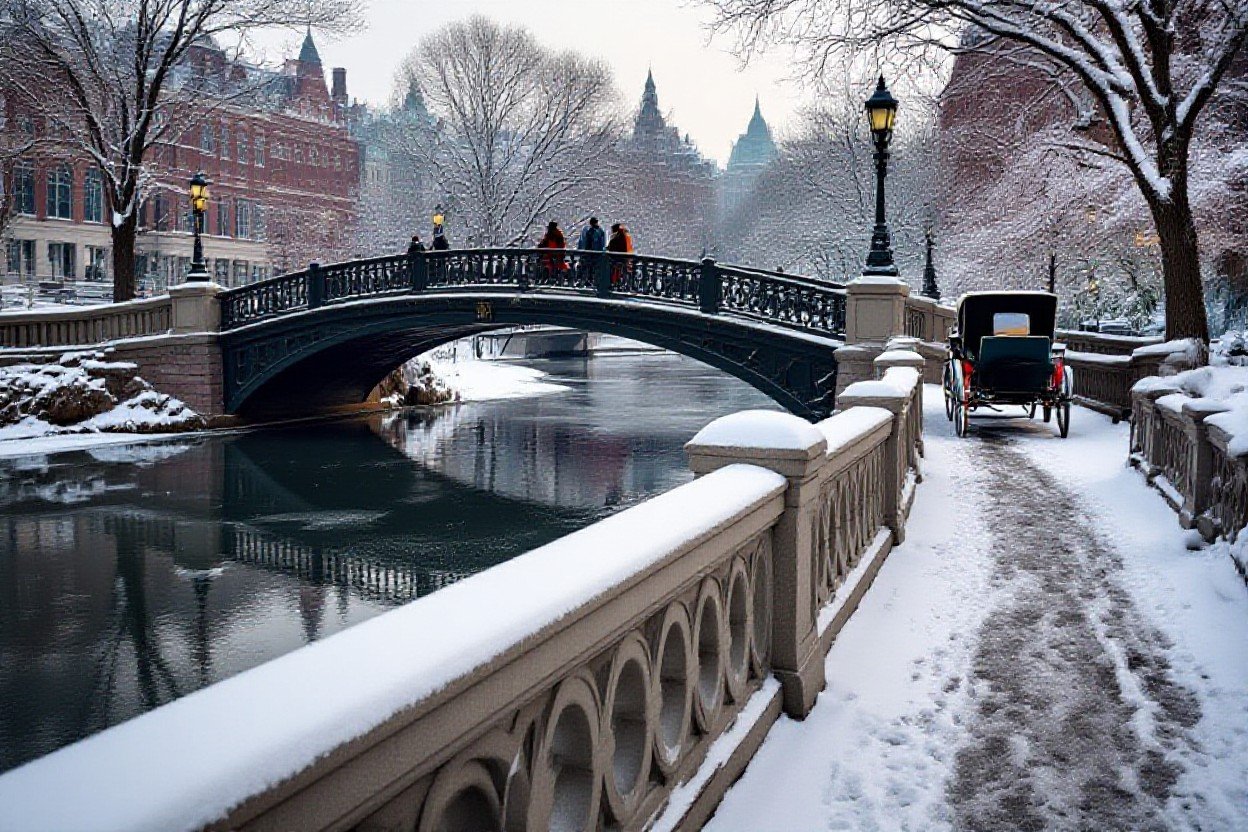
Navigating Central Park in Winter
I plan routes around daylight and footing: with December days dropping to roughly 9-9.5 hours, I aim for loops under two miles and return before dusk. I carry a fully charged phone, insulated layers, waterproof boots and microspikes when I expect packed snow; you should also factor in slower walking times-what feels like a mile on clear pavement can take 20-30 minutes on icy paths. I check the NYC Parks site for closures and favor paved, well-lit arteries when visibility is low.
Best Trails and Paths
I pick the Jacqueline Kennedy Onassis Reservoir loop (1.58 miles) for steady, paved footing and skyline views, and The Mall (the elm‑lined promenade between 66th and 72nd Streets) for a flat, wide walk. I avoid the Ramble and North Woods after snowfalls because stone steps and roots become slippery; instead you can use East and West Drives or the Conservatory Water area for gentler grades and clearer pathways.
Accessibility Considerations
I look for paved, level routes like the Reservoir loop and main drives when I need wheelchair-friendly paths, and I note that many interior trails have stone steps or uneven roots that become hazardous in winter. You should contact NYC Parks or 311 for the latest accessible route maps and temporary closures, and expect that snow‑clearing priority focuses on main arteries, not all secondary paths.
I also plan travel time and assistance: if you use a mobility device, I recommend microspike-compatible tires or attendants for icy stretches, a concise route under two miles to limit exposure, and confirming restroom and elevator availability in advance via NYC Parks, since winter maintenance can alter access to specific facilities.
Local Insights and Recommendations
Seasonal Events and Festivals
Wollman Rink runs its skating season through winter, and I often time visits around early evening when ice sessions overlap with holiday lights; admission typically sits around $15-25 and skate rentals $10-15. You can catch the Columbus Circle Holiday Market (mid-November to Dec 24) for artisanal gifts, and the Central Park Conservancy schedules guided winter walks and birding tours-I’ve joined ones that lasted 60-90 minutes and focused on owls and migratory patterns.
Nearby Amenities and Services
The Dairy Visitor Center (near 65th Street) offers maps, restrooms, and park info, and I use the Loeb Boathouse for heated restrooms and boat rentals; Citi Bike docks and public charging stations appear around Columbus Circle and along 59th Street for convenience. Within a 5-12 minute walk you’ll find coffee shops, ATMs, and pharmacies-if you need a quick kit, Duane Reade on 7th Avenue is about a 10-minute stroll.
For accessibility, I look for ramped entrances at the 72nd Street Transverse and the 5th Avenue/59th Street entry, and you can find ADA restroom maps on the park website; bring your own hand warmers on longer walks. I also plan a 15-20 minute buffer for finding available Citi Bike docks on busy weekends, and I favor routes that the Parks Department plows first-Bethesda, the Mall, and the 72nd Street transverse.
Conclusion
Now I have seen Central Park in December and I can tell you its atmosphere shifts to quiet, crystalline beauty with snow-dusted paths, bare-limbed trees and iconic skyline views; I recommend dressing in layers, bringing a camera, and giving your visit extra time so you can savor sights like Bethesda Terrace, the Reservoir and festive window displays while I guide you to the best vantage points.
